Showing posts with label Exodus 12. Show all posts

Sunday, May 19, 2024

Sermon for the Day of Pentecost: "What Does This Mean?" (Acts 2:1-21)


LISTEN

Grace, mercy, and peace be to you from God our Father and from our Lord and Savior Jesus Christ, who together send the promised Holy Spirit! Amen! 

Dear brothers and sisters in Christ:


“And [the devout Jews from every nation under heaven] were amazed and astonished, saying, ‘Are not all these who are speaking Galileans? And how is it that we hear, each of us in his own native language? … [They] all were amazed and perplexed, saying to one another, ‘What does this mean?’” (Acts 2:7-8, 12).


Fifty days after Christ’s resurrection and ten days after His ascension, the followers of Christ remain in Jerusalem. They wait. They are waiting under the command their Lord who said, “Behold, I am sending the promise of my Father upon you. But stay in the city until you are clothed with power from on high” (Luke 24:49). You see, Jesus was waiting for the perfect time. And that perfect time had come.


When God led the children of Israel out of Egypt, He had them observe the Passover the same night, and then He commanded them to celebrate the Passover the same time each year as a memorial of their deliverance and departure from Egypt (Exodus 12:14). From that day of the Passover, they traveled 50 days to Mount Sinai. There, upon Mount Sinai, God gave them the Law through Moses. This fiftieth day was also a day of importance. God, too, commanded them to observe a memorial day every year on the fiftieth day after Passover (Leviticus 23:15-21; Deuteronomy 16:9-12). 


This fiftieth day after Passover became known as the Feast of the Harvest, or the Feast of Weeks, or simply “Pentecost,” since it took place 50 days after the Passover Sabbath. So, every pious Jew tried to be in Jerusalem for this festival to bring their harvest of grains to the temple. So, on this day, they gathered up their baskets, then processed up Mount Zion as they sang the Psalms of Ascents (Psalm 120-136), then processed into the temple courts where they would present their baskets to the priests.


Pentecost was a major festival as it brought in people from all throughout the world into Jerusalem. For us, we celebrate the Pentecost festival not because of the old history, but because of its new history, because of the sending of the Holy Spirit. This was the perfect time to send the Third Person of the Trinity upon the people.


For the festival pilgrims, Pentecost began just like other Pentecost festivals before them. But this particular Pentecost was going to be unlike any other before it. As the pilgrims are processing through Jerusalem, they begin to hear familiar voices. Their ears perked up! They recognized the dialect. Now, they weren’t hearing the Aramaic of Judea, which most of them understood. They weren’t hearing the common Greek of the Roman Empire. “Hey! I’m hearing my language!” They all heard and understood the apostles speaking the language of their homeland!


To this, they were all bewildered. They were all amazed. They were all perplexed as they said to one another, “What does this mean?” (Acts 2:12)


What they were hearing was indeed a miracle! Now, this miracle was not in the hearing, but in the speaking of the apostles. Just like that, the Holy Spirit gave them the ability to speak in many languages! And just like that, the people heard. And they questioned what they heard. “What does this mean?”


Inspired by the Holy Spirit, St. Paul writes, “So faith comes by hearing, and hearing through the Word of Christ” (Romans 10:17). The Church is the people of God – the believers in Christ. But believers do not exist apart from the hearing of the Word of God. If people are not told about Jesus Christ and what Christ has done for them, they cannot believe it. So, while the Church is the people of God, it never exists apart from the Marks of the Church – Word and Sacrament. You see, without the message that Christ died on the cross for your sins, the Church does not exist. This crowd gathered because of the miracles that were taking place. They gathered as they said to one another, “What does this mean?”


But did you notice that these people, hearing their own language, did not come to faith until Peter had preached the Word of God to them? Yes, “faith comes by hearing,” but as St. Paul also says, “How then will they call on Him in whom they have not believed? How are they to believe in Him of whom they have never heard? How are they to hear without someone preaching?” (Romans 10:14)


So, Peter preaches to them the Word of God: “Men of Judea and all who dwell in Jerusalem, let this be known to you, and give ear to my words. … This is what was uttered through the prophet Joel: ‘And in the last days it shall be, God declares, that I will pour out My Spirit on all flesh’” (Acts 2:14, 16-17). Peter starts with the Old Testament and applies it to what Jesus had done. Peter preaches Law and Gospel to them. And when they understood what God had done and that they – because of their sins – bore responsibility for the death of Jesus, their consciences were cut open.  

So, they asked Peter, “What shall we do?” and Peter gave them the Gospel: “Repent and be baptized every one of you in the name of Jesus Christ for the forgiveness of your sins, and you will receive the gift of the Holy Spirit” (Acts 2:38). Three thousand were baptized that very day.


So, what did the Holy Spirit do that day? He gave the apostles the power to reach these pious Jews through the pure Word of God. You see, it was the purity of the Law and Gospel that caused Christ’s Church to grow. And the Holy Spirit works through us in every language to spread the Good News of salvation in Jesus Christ that is given to all by grace through faith in Christ alone.


Without the outpouring of the Holy Spirit, the promised Helper, our salvation in Christ would have been lost. It would have been forgotten. But with the Holy Spirit, He gave the apostles the confidence to preach the Word of the Cross that Jesus died and rose again to give us forgiveness of sins and life everlasting, that Jesus ascended back into heaven as Lord of heaven and earth, who will come again to judge the living and the dead.


But in order to fully understand the Gospel, one needs to see the importance of the Gospel. You see, if you believe you are not a sinner, then Jesus is of no importance to you. So, the Holy Spirit leads us to acknowledge our sins against God and our neighbor, so that we are ready to hear the message that through Christ’s atoning death, those sins are forgiven. The Holy Spirit is always pointing to Jesus. That is His job. So, He constantly reminds us that we have the Savior, who is Jesus Christ, our Lord. For “everyone who calls upon the name of the Lord shall be saved” (Acts 2:21).


There is also another thing to be noted by the pious Jews response this day: their question“What does this mean?” which is a question that is very familiar to us Lutherans. It is Luther’s question he asks throughout his Small Catechism.


Now, how many of us have been perplexed by Luther’s question? How many of us remain perplexed by Luther’s question? It’s certainly good to know the wordage of the Six Chief Parts of the Catechism. But we should never be shallow when it comes to Christian doctrine. Jesus, St. Paul, and Luther all desire that we do not remain as Christians who eat only baby food, but that we mature at eat steak. It’s all well and good to know the Ten Commandments, the Creed, and the Lord’s Prayer, but what do they mean? How do we fear, love, and trust in God? How do we truly love our neighbor? What does it really mean when we confess the Creed? How do we pray? 

How do these first three chief parts prepare us to understand the Sacrament of Holy Baptism, Confession, and the Sacrament of the Altar? What does this all mean? Now, the Catechism does give us so many answers, but not every answer to our every question. So, we must all continue to grow as we are nourished by the Holy Spirit through the Means of Grace. For if you are not nourished, your faith will wither and die. So, continue to chew on God’s Word and inwardly digest it, so that you grow in faith and bear fruits of faith.


Confirmation Sunday so often is equated with graduation. The reality is – it isn’t. If confirmation were a graduation, there would be no need for Bible Studies, Christian colleges, and seminaries. There would be no need to continue coming to the Divine Service. But confirmation is a commencement. Confirmation is a beginning. Joshua, in just mere moments, you will be confirming your faith in Jesus Christ. You will vow your allegiance to Him, who suffered and died for you, who rose from the dead for you, who is ascended into heaven for you. You will state your intention to continue steadfast in this confession and Church and to suffer all, even death, rather than fall away from it. You will be hated by the fallen world for what you are about to do, but as your confirmation verse says: “Be faithful unto death, and [you will receive] the crown of life” (Revelation 2:10b).


Now, you will be tempted to abandon Jesus. Satan will tempt you even more than he already has after today. He will use tactics that promote doubt, and his fallen world will criticize and persecute you. So, I pray that you call upon the name of Jesus, receive His gifts in Word and Sacrament, recall the Catechism, for you have the spiritual weapons to fight off Satan’s lies and deceit. May you never forget that.


Today, we celebrate the outpouring of the Holy Spirit, but do you all know that this outpouring continues today and everyday wherever the Gospel is preached? From the very beginning, the one holy Christian and apostolic Church has been about the Word. For Joshua, and all of us here today, may we never forget that Word and Sacrament is at the center of everything. It is the Holy Spirit inspired Word of God that clearly communicates all what the triune God has done for us, that we have the Savior Jesus Christ, that by Him becoming man, His death on the cross, His resurrection from the grave, and His bodily ascension into heaven, we are called to repentance and faith in Him for in Him we receive forgiveness of our sins, life, and salvation and all by grace through faith in Him, who is proclaimed by the Holy Spirit. Amen.


The peace of God, which surpasses all understanding, keep your hearts and minds in Christ Jesus, our Lord. Amen.  + SOLI DEO GLORIA +

Sunday, January 15, 2023

Sermon for Epiphany 2: "The Power of the Spoken Word" (John 1:29-42a)

Grace, mercy, and peace be to you from God our Father and from our Lord and Savior Jesus Christ! Amen! Dear brothers and sisters in Christ: 

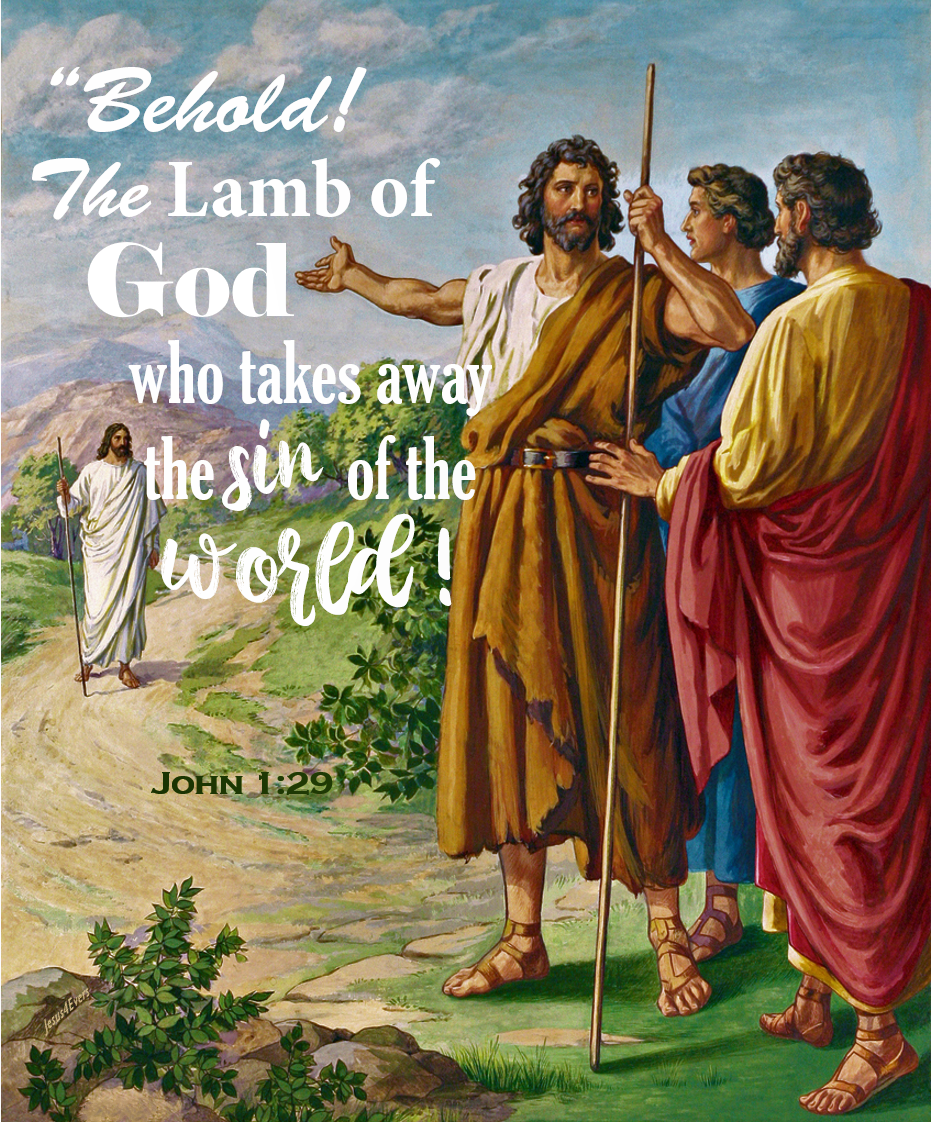
“Behold, the Lamb of God, who takes away the sin of the world!” (John 1:29)


John the Baptist had gained quite a number of disciples. But John knew that such discipleship would not be permanent. He knew he was only the forerunner to the promised Messiah. And John did not resent or resist that prospect. In fact, John rejoiced over it. He gladly said: “He – Jesus – must increase, but I must decrease” (John 3:30). So, John would gladly recede into the background as Jesus came to the foreground.


So, seeing Jesus coming toward him, John called out to his disciples, “Behold, the Lamb of God, who takes away the sin of the world!”


By saying “behold,” John is saying to his disciples: “Look! Turn your eyes over there! Don’t miss this! That Man is the Lamb of God, who takes away the sin of the world!”


But how did John know? Well, he tells us what he witnessed at Christ’s baptism! “I saw the Spirit descend from heaven like a dove, and it remained on him” (John 1:32). You see, it wasn’t from his own reason that He knew Jesus to be the Christ. Instead, it was revealed to him. The Holy Spirit revealed to him that “He on whom you see the Spirit descend and remain, this is he who baptizes with the Holy Spirit” (John 1:33).


Like St. Peter, who would later say to Jesus: “You are the Christ, the Son of the living God” (Matthew 16:16), this was revealed to Peter not by reason, but by “My Father who is in heaven,”Jesus says (Matthew 16:17).


We are in the season of Epiphany. Throughout this season, Jesus is revealed to be the Messiah, the Son of God, in various ways. Today, we hear how Jesus was revealed as the Son of God through the proclamation of the Word. Through the proclamation and power of the spoken word, Jesus wins His first disciples.


“Behold, the Lamb of God, who takes away the sin of the world!” Following the Baptism of Jesus in the Jordan River by John, John came to realize what had just happened. He baptized the very Son of God. Yes, he attempted to decline Jesus, because Jesus knew no sin. But today, we hear the rest of the story. All of what happened that day in the Jordan River was revealed to him before Jesus broke the tension with John when He spoke, “Let it be so now, for thus it is fitting for us to fulfill all righteousness” (Matthew 3:15).


Suddenly, John realized. He remembered. He had an epiphany. He baptized the sinless One, so that Jesus would be the sin-bearer.


So, again as Jesus came walking toward John, John speaks to get the attention of his disciples, “Behold, the Lamb of God, who takes away the sin of the world!”


Then, the next day, John speaks again as Jesus walks by: “Behold, the Lamb of God!”


Now, upon hearing these words, every devout Jew knew that these words could only refer to the promised Messiah. For one thing, every sacrifice of a lamb, especially that of the Passover lamb, was a type, a direction sign, which pointed forward to the coming Redeemer.


“Look! Jesus is the Lamb of God! There is the Man you need to follow! There is the long-awaited Savior! Why are you standing here with me? Go to Him!”


Jesus is the Lamb of God who came to give Himself as the sacrifice to win forgiveness for a sinful world. He is the Passover Lamb whose blood saves us from death (Exodus 12:1-13). He is the burnt offering “without defect” (Leviticus 1:10). He is the sin offering through which we receive forgiveness. He is to be the lamb “led to the slaughter” for our sins (Isaiah 53:7).


Here, John the Baptist is proclaiming Jesus’ mission. Jesus is “the Lamb of God, who takes away the sin of the world!” John is pointing forward to Christ’s atoning work upon the cross. Jesus didn’t come just to forgive the sins of certain people. He came for the entire sin of the entire world. He came to take away all the sins of every sinner, from Adam down to the last transgressor born before the Last Day. 


All this sin, Jesus as the Lamb of God takes away with His one tremendous sacrifice as the spotless Lamb who would carry out God’s grand design: to cancel the sins of all mankind. This is known as universal justification. But don’t be confused. This has nothing to do with universalism where all are saved no matter what they believe. 


Instead, universal justification means that Jesus came to save everyone who believes and trusts in Him. For everyone who trusts in Him, they are freed from the power of sin. This is what Jesus proclaims: “For God did not send His Son into the world to condemn the world, but in order that the world might be saved through Him. Whoever believes in him is not condemned, but who ever does not believe is condemned already, because he has not believed in the name of the only Son of God” (John 3:17-18).


“Behold, the Lamb of God!” After two of John’s disciples heard this proclaimed, they followed Jesus. Jesus then turned and saw them following Him and said to them: “What are you seeking?” (John 1:38) That is a most-important question. Here we have two faithful Jews who have long been seeking the Messiah. What were they seeking?


Could they be seeking a Messiah who would bring freedom from the Romans? Could it be a Messiah who would restore Jerusalem and Jewish power? Could it be a Messiah who would be a miracle worker?


How might we respond? Are you seeking help coping with daily burdens? Seeking a life made easy? What are we seeking from Jesus?


All of humanity is seeking something. Sometimes, we just don’t know what. Since most people do not know what they are really seeking, they continue to seek. Some seek power, for with power, they can do whatever they want. Some seek wealth. Like power, you can do a lot with wealth. You can buy whatever you want. Some seek knowledge. But sometimes it isn’t about knowledge, instead knowledge may be used to impress others, or even to control others, or to attempt to solve the world’s problems all on their own. Others, seek popularity. Who doesn’t desire to be liked? This is the whole point behind social media. But what do power, wealth, knowledge and popularity all have in common? They are fleeting. Each of these things lead to the same result: death.


Without knowing it, what most people are really seeking is a Savior from sin and its effects. We are seeking a sense of identity. We are seeking a sense of security. We are seeking meaning and purpose.


What we are really seeking, God provides. “Behold, the Lamb of God, who takes away the sin of the world!”


In fact, this is what John’s two disciples were seeking. They said to Jesus, “Rabbi, where are you staying?” You see, they wanted to stay with Jesus, learn from Him, and get from Him what He had to offer them – the forgiveness of sins. Jesus replies, “Come and you will see.”


In Christ, our identity is restored as a redeemed child of God. The sin that alienated us from God and others is forgiven. In Christ, our security is restored. We are reconciled to God since our sin is removed, so that while we live or when we die, we are certain that we are protected by God. In Christ, our meaning and purpose is restored. We are children of God with a vocation: to love God and serve my neighbor.


Immediately, as the two disciples are told “Come and you will see” by Jesus, one of them, Andrew, tells his brother Simon Peter, “We have found the Messiah!” He brought him to Jesus.


This is the Church’s mission. Word and Sacraments are God’s means for transmitting salvation, but we are the human agents who bring those means to bear on people.  Through Andrew, we see the early church’s involvement in Jesus’ mission on a one-on-one basis. John the Baptist tells two of his disciples about Jesus. Then one of them, Andrew, tells his brother about Jesus. And so it goes on through human history, and so the church grows one by one.


Through the spoken word, we hear and follow Jesus. The Apostle Paul proclaims, “So faith comes from hearing, and hearing through the Word of Christ” (Romans 10:17).


So, like John the Baptist and Andrew, through the working of the Holy Spirit in us, we testify of Jesus in who He is – “the Lamb of God, who takes away the sin of the world.” He is what the world is seeking. We invite our friends and neighbors saying, “Come and see!” We invite, so that others can hear and see Jesus in this place. Here in the Divine Service, we come to see, learn, believe, and follow Jesus as He comes to us through His Word and Sacraments! Amen.


The peace of God, which surpasses all understanding, keep your hearts and minds in Christ Jesus, our Lord. Amen. 


+ SOLI DEO GLORIA +
Tuesday, April 28, 2020

Christ Jesus Lay in Death's Strong Bands

"Christ Jesus Lay in Death's Strong Bands" (LSB 458) is Martin Luther's Easter hymn.
The hymn begins by echoing the words of St. Luke: "God raised Him up, loosing the pangs of death, because it was not possible for Him to be held by it" (Acts 2:24). Christ's resurrection brings us life and salvation: "He will swallow up death forever" (Isaiah 25:8). In faith, the Christian joyfully praises the Lord for all He has done for us!
In stanza two, Luther writes of the Law's harshest condemnation of sin and its consequence: death.
In stanzas three and four, Luther tells of what Christ has done for us, sinners. He tells of Christ's struggle, victory, salvation and redemption for us!
In stanzas five and six, Luther tells of Christ's victory on the cross over sin, death, and hell. Also, in stanza five, Luther tells of Jesus as the Passover lamb (Exodus 12) and how His blood marks the Door to eternal life.
In the final stanza, Luther tells how Christ feeds our souls at the Sacrament of the Altar: "Christ alone our souls will feed; He is our meat and drink indeed; faith lives upon no other!"
Each stanza concludes with a bold Easter "alleluia," for Christ is victorious over sin, death, and the power of the devil!
Alleluia! Christ is risen! He is risen, indeed! Alleluia!
1 Christ Jesus lay in death’s strong bands
For our offenses given;
But now at God’s right hand He stands
And brings us life from heaven.
Therefore let us joyful be
And sing to God right thankfully
Loud songs of alleluia!
Alleluia!
2 No son of man could conquer death,
Such ruin sin had wrought us.
No innocence was found on earth,
And therefore death had brought us
Into bondage from of old
And ever grew more strong and bold
And held us as its captive.
Alleluia!
3 Christ Jesus, God’s own Son, came down,
His people to deliver;
Destroying sin, He took the crown
From death’s pale brow forever:
Stripped of pow’r, no more it reigns;
An empty form alone remains;
Its sting is lost forever.
Alleluia!
4 It was a strange and dreadful strife
When life and death contended;
The victory remained with life,
The reign of death was ended.
Holy Scripture plainly saith
That death is swallowed up by death,
Its sting is lost forever.
Alleluia!
5 Here our true Paschal Lamb we see,
Whom God so freely gave us;
He died on the accursèd tree—
So strong His love—to save us.
See, His blood now marks our door;
Faith points to it; death passes o’er,
And Satan cannot harm us.
Alleluia!
6 So let us keep the festival
To which the Lord invites us;
Christ is Himself the joy of all,
The sun that warms and lights us.
Now His grace to us imparts
Eternal sunshine to our hearts;
The night of sin is ended.
Alleluia!
7 Then let us feast this Easter Day
On Christ, the bread of heaven;
The Word of grace has purged away
The old and evil leaven.
Christ alone our souls will feed;
He is our meat and drink indeed;
Faith lives upon no other!
Alleluia!
Text: Public domain